Pricing - Based Call Admission Control for Wireless MPEG-4 Traffic
Computer Communications Journal, Elsevier Publ., Vol. 32, No. 17, 2009, pp. 1781-1789
Overview
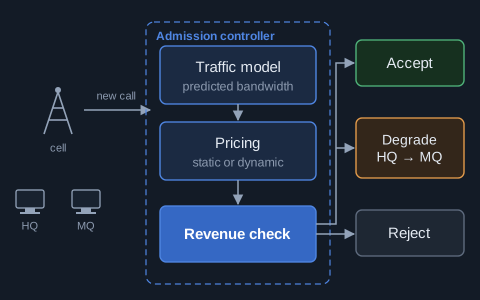
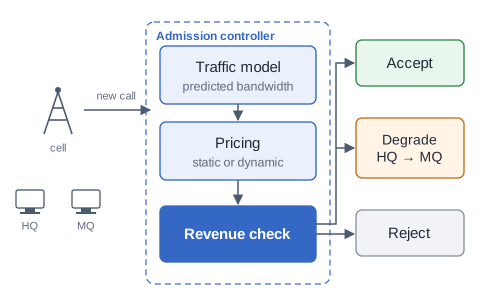
Couples traffic modeling with economics: a call admission controller for MPEG-4 videoconferencing that accepts or degrades calls based on predicted bandwidth and the revenue each decision brings the provider.
Key contributions
- New traffic model for medium-quality MPEG-4 videoconference streams.
- Revenue-maximizing admission control that works under static and dynamic pricing.
- Keeps high-quality users satisfied while using the network close to its predicted capacity.
Abstract
Next generation wireless technologies will need to incorporate new sets of traffic control procedures in order to cope with the challenges related to supporting both the existing and the ever-increasing new multimedia services. The work presented in this paper focuses on traffic control for MPEG-4 videoconference over cellular networks, and is twofold. We first introduce a traffic model for medium quality MPEG4 videoconference traffic. We then proceed to use this model, as well as a previously developed model for high quality MPEG-4 traffic, in the implementation of a new Call Admission Control (CAC) mechanism. Providers need to use efficient resource management mechanisms in order to keep existing clients satisfied and attract new customers, so that they can increase their revenue. Towards this goal, our CAC mechanism makes decisions on the acceptance/rejection of a new video call not only based on the predicted capacity that users will consume, but also on the possible revenue gained for the provider when degrading current users in order to accommodate new ones. Our mechanism is implemented with both a static and a dynamic pricing policy and is shown, via an extensive simulation study, to provide excellent Quality of Service (QoS) to wireless videoconference users.
Cite this paper
@article{DBLP:journals/comcom/LazarisK09,
  author    = {Aggelos Lazaris and
               Polychronis Koutsakis},
  title     = {Pricing-based call admission control for wireless {MPEG-4} traffic},
  journal   = {Computer Communications},
  volume    = {32},
  number    = {17},
  pages     = {1781--1789},
  year      = {2009},
  url       = {https://doi.org/10.1016/j.comcom.2009.06.013},
  doi       = {10.1016/j.comcom.2009.06.013},
  timestamp = {Fri, 27 Dec 2019 00:00:00 +0100},
  biburl    = {https://dblp.org/rec/bib/journals/comcom/LazarisK09},
  bibsource = {dblp computer science bibliography, https://dblp.org}
}