Angelos Lazaris

Data Science Lead · PhD, Electrical Engineering

Angelos Lazaris

I use data and AI to improve the performance and reliability of complex systems, end to end. As a Data Science Lead at Meta, my work spans improving content discovery on the Facebook app with state-of-the-art AI models, measuring and improving the quality of Meta AI at Meta Superintelligence Labs, and platform quality and reliability for the Family of Apps. Before that, as Chief Data Scientist at Pixalate, I worked on advertising fraud detection and publisher and inventory quality, finding anomalies in very large streams of traffic.

I received my PhD in Electrical Engineering from the University of Southern California, and my MSc and 5-year Diploma in Electronic and Computer Engineering from the Technical University of Crete, Greece. Here you can find more about my academic research and research interests, which lie at the intersection of artificial intelligence, telemetry, and distributed systems.

The information on this website is not related to my proprietary work in industry.

Research interests

Focus areas

Machine Learning and AI Systems

LLMs and foundation models in production, agentic AI and multi-agent workflows, retrieval-augmented generation (RAG), LLM-as-a-judge and other evaluation methods, and AI-powered recommendation and content discovery.

Performance, Quality and Reliability of AI Systems

AI observability and evals in production: latency, token cost and efficiency, hallucination and drift detection, guardrails, failure analysis of agents and tool calls, and SLOs for AI systems.

Anomaly Detection and Traffic Modeling

Time series forecasting with sequence and foundation models, real-time anomaly and fraud detection in high-volume event streams, and invalid-traffic and bot detection.

Network Telemetry and SDN

Fine-grained network telemetry and measurement, OpenTelemetry-style tracing and metrics pipelines, measurement orchestration, and ML-driven management of software-defined networks.

Selected publications

Highlights
2021TNSM
An LSTM Framework for Software-Defined Measurement

IEEE Transactions on Network and Service Management (TNSM), 2021

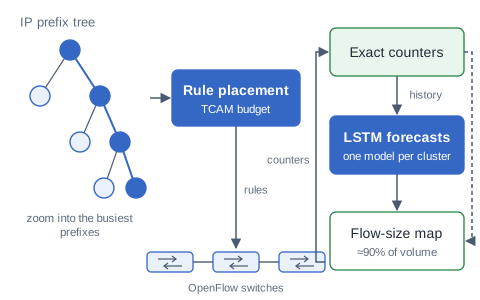
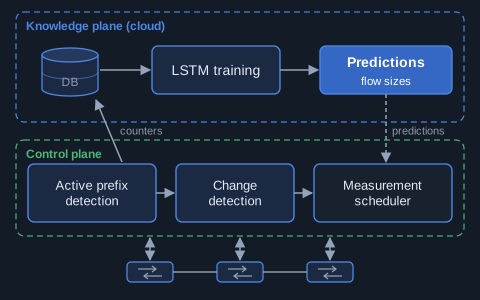
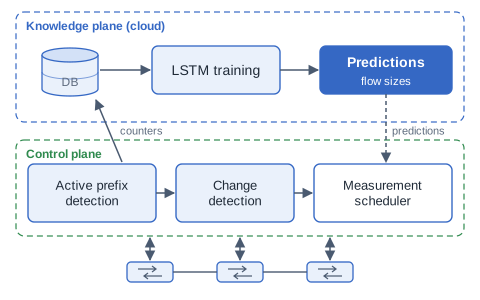
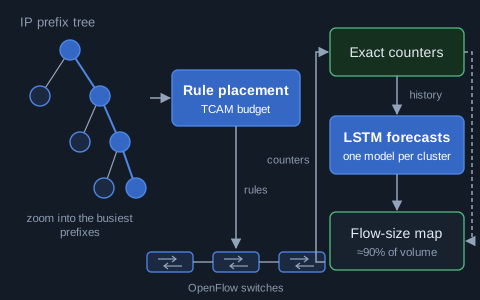
DeepFlow makes fine-grained traffic measurement scale on real SDN hardware: it spends scarce switch TCAM on the most active prefixes and uses LSTM forecasts to fill in the flows it cannot measure directly.

Publications

Peer-reviewed

Journal papers 8

  1. 2021TNSM
    An LSTM Framework for Software-Defined Measurement

    A. Lazaris and V.K. Prasanna

    IEEE Transactions on Network and Service Management (TNSM), Special Issue on Data Analytics and Machine Learning for Network and Service Management, Vol. 18, No. 1, pp. 855-869, 2021

    DeepFlow makes fine-grained traffic measurement scale on real SDN hardware: it spends scarce switch TCAM on the most active prefixes and uses LSTM forecasts to fill in the flows it cannot measure directly.

    • Adaptive active-flow detection that zooms into the busiest source/destination IP prefixes and places measurement rules where they cover the most flows.
    • LSTM flow-size prediction from past measurements (around 16% MAPE on real traces), with feature-based clustering so one model serves many similar flows.
    • Up to 2x more flows observed for the same switch memory, reaching about 90% coverage of total traffic volume.
  2. 2017HCCIS
    Video Scene Identification And Classification For User-tailored QoE in GEO Satellites

    P. Koutsakis, I. Spanou, and A. Lazaris

    Human-centric Computing and Information Sciences, 7, 1, Article 96 (December 2017), 18 pages, 2017

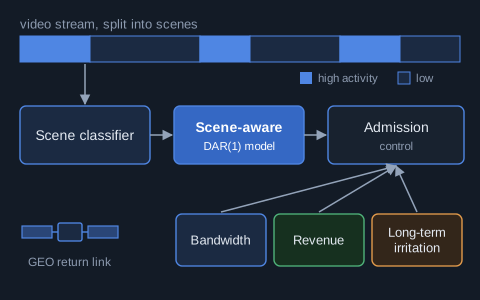
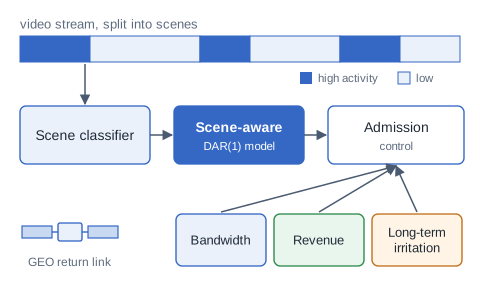
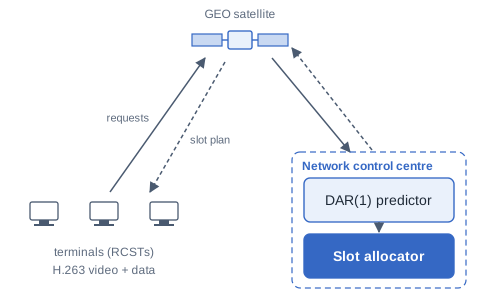
    Brings video scene identification and classification into satellite resource allocation, so admission and scheduling decisions track each user's long-term Quality of Experience, not just average QoS.

    • Scene-level traffic model that separates high- and low-activity scenes in bursty video.
    • Introduces long-term user satisfaction (“irritation”) into call admission control, alongside bandwidth and provider revenue.
    • Handles up to 59% system load under a 0.1% packet-drop target, beating published schemes (32% to 52%), and cuts long-term user irritation by 27%.
  3. 2014TMM
    Activity-Based Video Traffic Policing: A New Paradigm

    E. Maratsolas, P. Koutsakis, and A. Lazaris

    IEEE Transactions on Multimedia, vol.16, no.5, 2014, pp.1446-1459

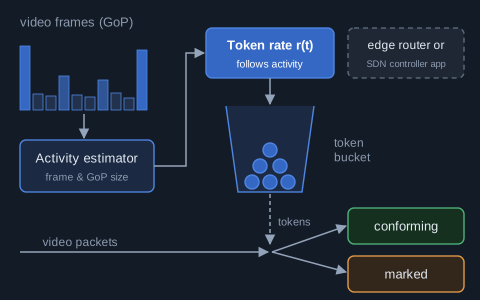
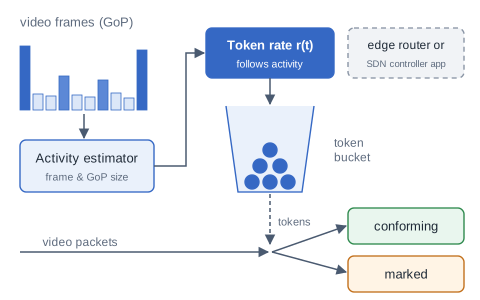
    Proposes a new paradigm for policing bursty video: instead of fixed-rate token generation, the policer adapts to the video's own activity and Group-of-Pictures structure, in edge routers or as an SDN controller application.

    • Five activity-aware policing mechanisms that vary the token rate using recent frame and GoP sizes.
    • The Frame-Size-Aware Token Bucket reduces wrongly marked traffic from conforming users by 63% versus the classic approach.
    • Matches classic policers on catching non-conforming users, so the gain comes without weaker enforcement.
  4. 2010COMCOM
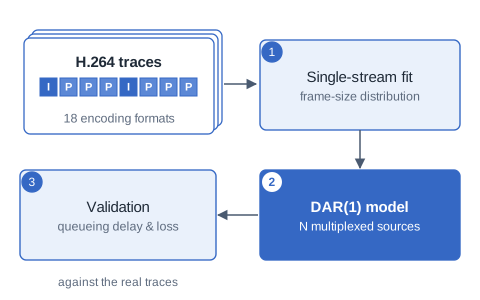
    Modeling Multiplexed Traffic from H.264/AVC Videoconference Streams

    A. Lazaris and P. Koutsakis

    Computer Communications Journal, Elsevier Publ, Vol. 33, No. 10, 2010, pp. 1235-1242

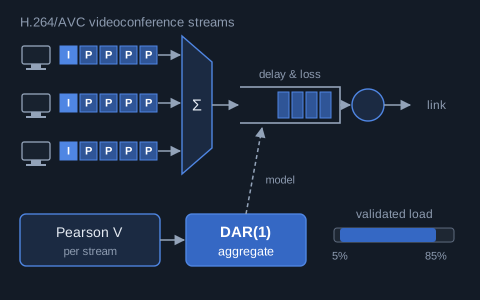
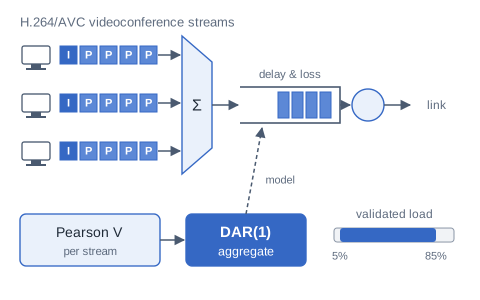
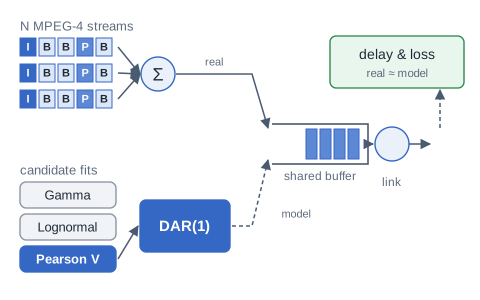
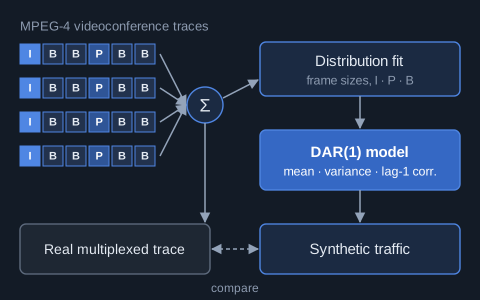
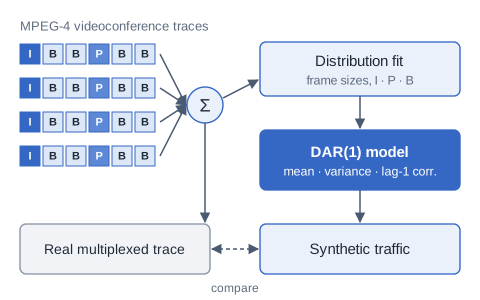
    Shows how to model the aggregate traffic of many multiplexed H.264/AVC videoconference streams with a simple Discrete Autoregressive model built from per-stream statistics.

    • Fits single H.264 streams against common distributions and identifies Pearson type V as the best fit.
    • Builds a DAR(1) model that accurately reproduces queueing delay and packet loss of multiplexed sources at loads from 5% to 85%.
  5. 2010TMM
    Energy Efficient H.263 Video Transmission in Power Saving Wireless LAN Infrastructure

    A.M. Kholaif, T.D. Todd, P. Koutsakis and A. Lazaris

    IEEE Transactions on Multimedia, Vol. 12, No. 2, 2010, pp. 142-153

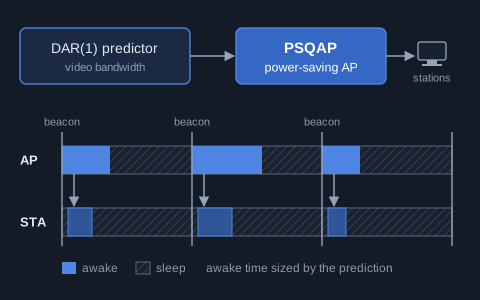
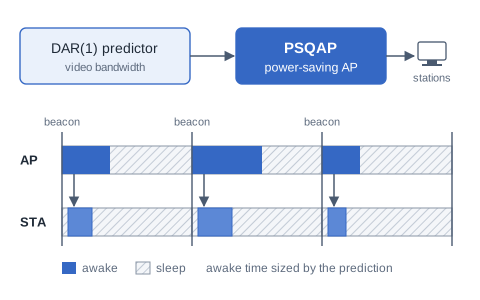
    Makes Wi-Fi access points themselves power-saving while still carrying real-time video, using traffic prediction to schedule bursty H.263 streams around sleep periods.

    • MAC protocol extensions for a power-saving, QoS-enabled 802.11 access point (PSQAP).
    • Several video scheduling schemes with analytical models that trade off access-point and client energy.
    • Best results from a new Power Save Multi-Poll variant driven by a discrete autoregressive bandwidth predictor.
  6. 2010WINET
    A New Bandwidth Allocation Mechanism for Next Generation Wireless Cellular Networks

    P. Koutsakis, M. Vafiadis and A. Lazaris

    ACM Wireless Networks Journal, Vol. 16, No. 2, 2010, pp. 331-353

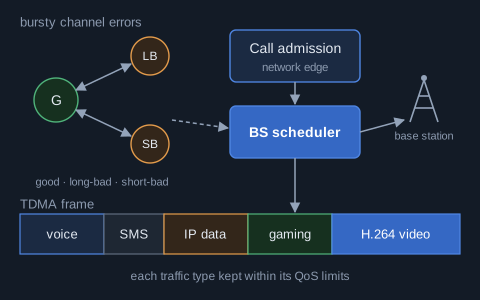
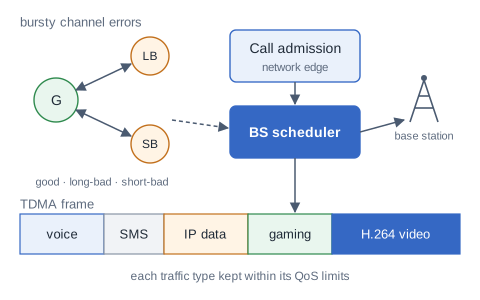
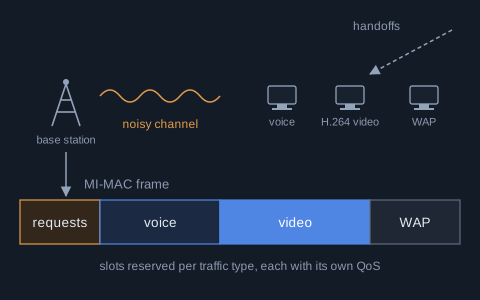
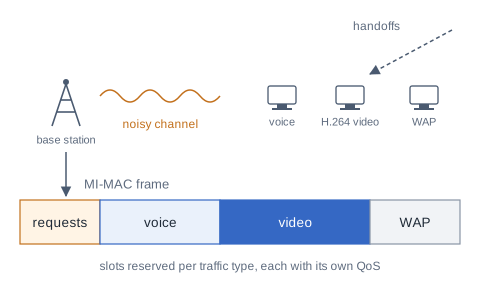
    Designs a medium access control protocol that lets voice, messaging, IP data, online gaming and H.264 video share a high-speed cellular TDMA channel with errors, while keeping each traffic type within its QoS limits.

    • One of the first studies to integrate real H.264 video traces and gaming traffic with other traffic over wireless.
    • Base-station scheduling combined with call admission control at the network edge.
    • About 7% to 10% higher throughput than competing protocols and 16% to 28% more voice capacity on average.
  7. 2009COMCOM
    Pricing - Based Call Admission Control for Wireless MPEG-4 Traffic

    A. Lazaris and P. Koutsakis

    Computer Communications Journal, Elsevier Publ., Vol. 32, No. 17, 2009, pp. 1781-1789

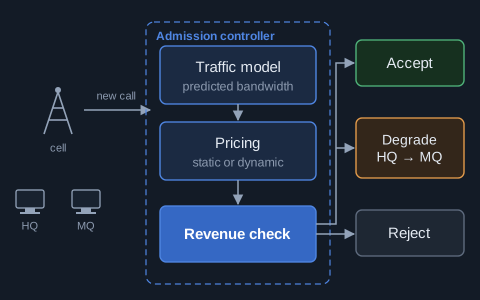
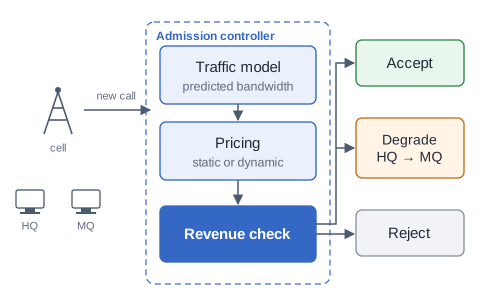
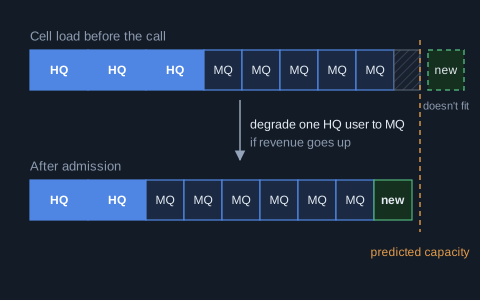
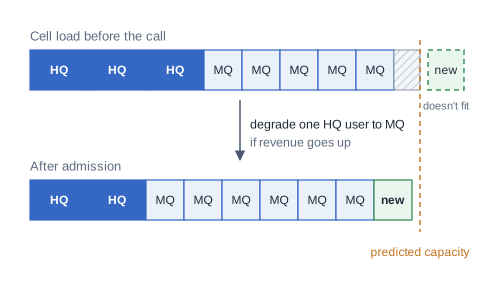
    Couples traffic modeling with economics: a call admission controller for MPEG-4 videoconferencing that accepts or degrades calls based on predicted bandwidth and the revenue each decision brings the provider.

    • New traffic model for medium-quality MPEG-4 videoconference streams.
    • Revenue-maximizing admission control that works under static and dynamic pricing.
    • Keeps high-quality users satisfied while using the network close to its predicted capacity.
  8. 2008PEVA
    A new model for video traffic originating from multiplexed MPEG-4 videoconference streams

    A. Lazaris, P. Koutsakis and M. Paterakis

    Performance Evaluation Journal, Elsevier Publ., Vol. 65, No. 1, 2008, pp. 51-70

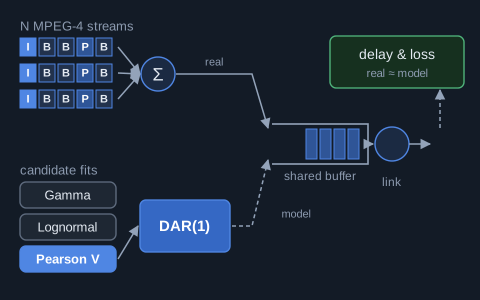
    A model for the traffic generated when many MPEG-4 videoconference streams share a link, so networks can be dimensioned for video without replaying real traces.

    • Shows that Gamma and lognormal, the usual choices for video, are not the best fit for MPEG-4 videoconference; Pearson type V is.
    • Builds a DAR(1) model that captures the multiplexed traffic, validated on queueing delay and packet loss.

Conference and workshop papers 14

  1. 2019CNSM
    Deep Learning Models For Aggregated Network Traffic Prediction

    A. Lazaris, V.K. Prasanna

    In Proc. of the 15th International Conference on Network and Service Management (CNSM), Halifax, Canada, October 2019

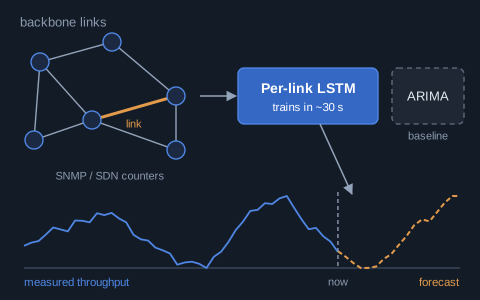
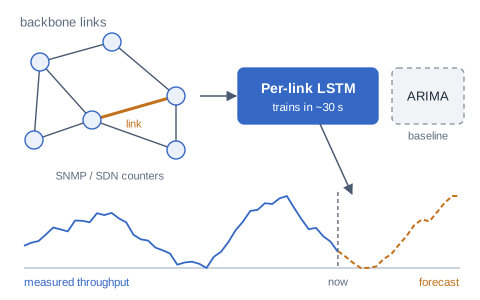
    Predicts link-level throughput across a backbone network seconds ahead using LSTMs trained on statistics that SDN controllers or SNMP already collect.

    • Analysis of how well LSTMs model aggregated traffic at different aggregation levels and short time scales.
    • Prediction framework deployable on production SDN or legacy networks without extra instrumentation.
    • Per-link LSTMs train in about 30 seconds and cut error by up to 2x compared with ARIMA baselines on Tier-1 ISP traces.
  2. 2019MEMSYS
    Predicting Memory Accesses: The Road to Compact ML-driven Prefetcher

    A. Srivastava, A. Lazaris, B. Brooks, R. Kannan, and V.K. Prasanna

    In Proc. of the ACM/IEEE MemSys 19, Washington DC, USA, September 2019

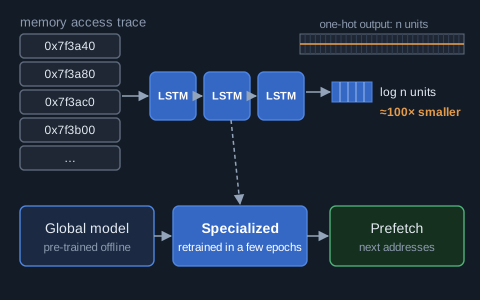
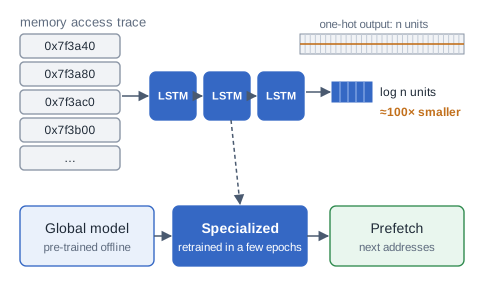
    Takes the first step toward machine-learned hardware prefetchers by shrinking LSTM memory-access predictors by orders of magnitude while keeping their accuracy.

    • Output-encoding compression that reduces LSTM parameters by a theoretical factor of n/log n.
    • About 100x smaller models (up to 1000x in experiments) with only a small accuracy loss.
    • Retrains in a few epochs from a short trace, making online learning practical; improves prefetch coverage over state-of-the-art prefetchers in simulation.
  3. 2019AnNet
    An LSTM Framework For Modeling Network Traffic

    A. Lazaris, V.K. Prasanna

    In Proc. of the 4th IEEE/IFIP International Workshop on Analytics for Network and Service Management (in conjunction with the IFIP/IEEE International Symposium on Integrated Network Management), Washington DC, USA, April 2019

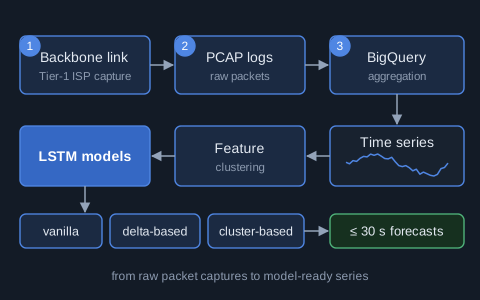
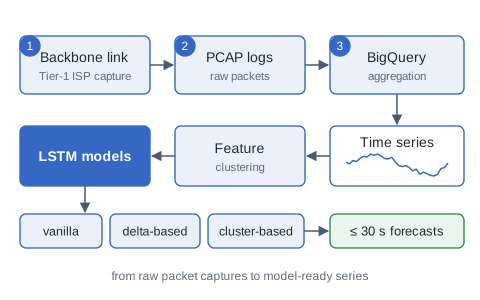
    Builds a big-data pipeline for raw ISP packet captures and uses it to show that LSTMs can forecast backbone traffic at time scales of 30 seconds or less.

    • End-to-end architecture that turns large PCAP logs from a Tier-1 ISP into model-ready time series.
    • Comparison of vanilla, delta-based and cluster-based LSTM variants.
    • Feature-based clustering so a single model serves each group of similar traffic sources.
  4. 2017CAN
    DeepFlow: A Deep Learning Framework For Software Defined Measurement

    A. Lazaris, V.K. Prasanna

    In Proc. of the Cloud-Assisted Networking Workshop (in conjunction with ACM CoNEXT 2017), Seoul Korea

    Introduced DeepFlow: SDN measurement that combines exact flow counters on hardware switches with cloud-trained deep learning predictions for flows that don't fit in switch memory.

    • Adaptive detection of the most active IP prefixes, measured at fine granularity, with coarser counters elsewhere.
    • LSTM models that predict flow sizes when exact counters cannot be installed.
    • Measures far more flows than sampling-based approaches, without their accuracy loss.
  5. 2014CoNEXT
    Tango: Simplifying SDN Programming with Automatic Switch Behavior Inference, Abstraction, and Optimization

    A. Lazaris, D. Tahara, X. Huang, L.E. Li, A. Voellmy, Y.R. Yang, M. Yu

    In Proc. of the 10th ACM International Conference on emerging Networking Experiments and Technologies (CoNEXT), Sydney, Australia, December 2014

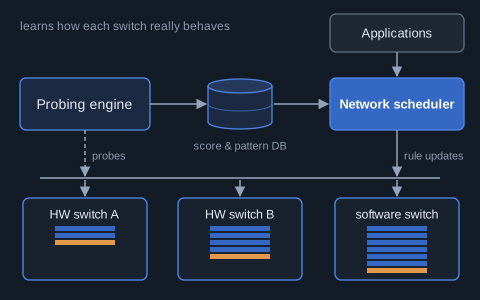
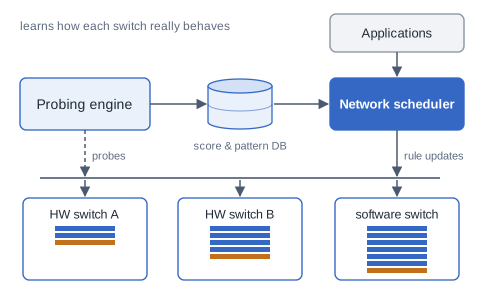
    Tango lets SDN controllers handle the hidden diversity of real OpenFlow switches: it probes each switch to learn how it really behaves, then optimizes how rules are installed.

    • Probing engine that infers switch properties, such as flow-table size, within 5% of the true value.
    • Simple API for applications to state requirements, with automatic rewriting into the fastest equivalent switch operations.
    • Up to 70% faster rule installation on hardware switches.
  6. 2014ONS
    Jive: Performance Driven Abstraction and Optimization for SDN

    A. Lazaris, D. Tahara, X. Huang, L.E. Li, A. Voellmy, Y.R. Yang, M. Yu

    In Proc. of the Open Networking Summit (Research Track), Santa Clara, CA, March 2014

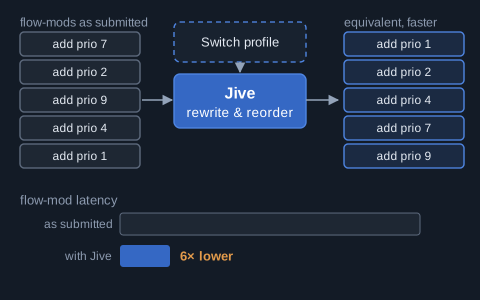
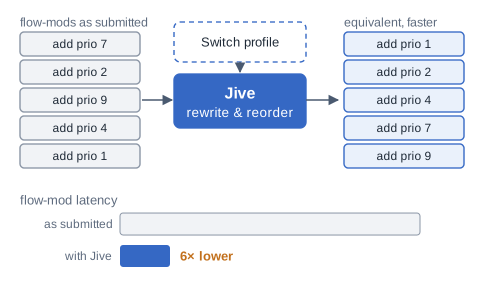
    Jive, the short paper that preceded Tango: performance-driven abstraction and optimization for SDN controllers in the presence of diverse switch implementations.

    • Measures switch-specific behavior automatically instead of trusting vendor reports.
    • Rewrites flow updates into equivalent but faster operations, giving a 6x lower flow-mod latency in one case.
  7. 2013ICC
    Scene Change Detection-Based Discrete Autoregressive Modeling for MPEG-4 Video Traffic

    I. Spanou, A. Lazaris, and P. Koutsakis

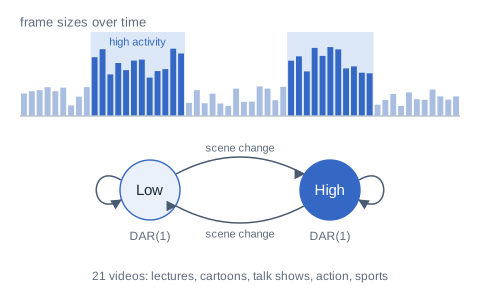
    In Proc. of the IEEE ICC, Budapest, Hungary, June 2013

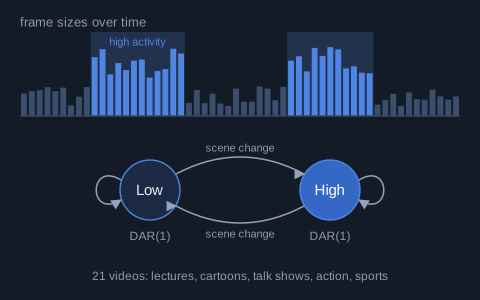
    A hybrid traffic model for MPEG-4 video that pairs a lightweight DAR(1) model with scene-change detection, for much better accuracy on bursty content.

    • Studies 21 videos across genres such as lectures, cartoons, talk shows, action and sports.
    • Two-state Markov chain that switches between high- and low-activity scenes on top of DAR(1).
    • Keeps the model cheap (four traffic parameters) while improving accuracy considerably.
  8. 2012WoWMoM
    User Satisfaction-Based Resource Allocation for GEO Satellites

    C. Stamos, D. Vasileiadou, G. Koutsandria, I. Spanou, A. Vlachaki, A. Lazaris and P. Koutsakis

    In Proc. of the IEEE WoWMoM, San Francisco, CA, USA, June 2012

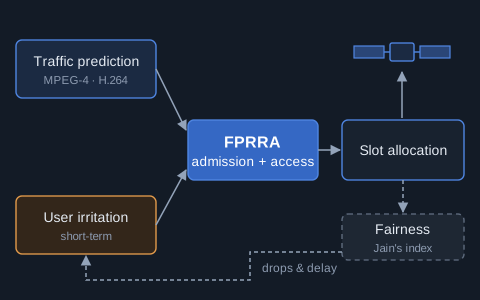
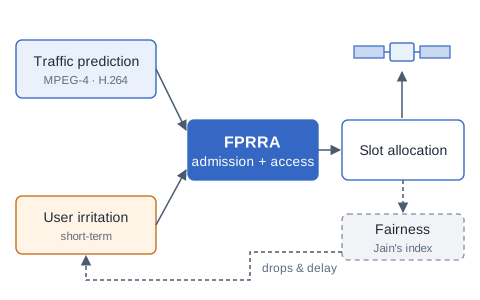
    Extends FPRRA, a joint admission and access control framework for satellite links, so it accounts for user satisfaction and still performs well when video traffic is hard to model.

    • Two definitions of short-term user irritation built into the scheduler.
    • Evaluation on highly bursty MPEG-4 and H.264 traces where prediction is less accurate.
    • Fairness analysis with Jain's index.
  9. 2008GLOBECOM
    Modeling Video Traffic from Multiplexed H.264 Videoconference Streams

    A. Lazaris and P. Koutsakis

    In Proc. of the IEEE GLOBECOM, New Orleans, USA, December 2008

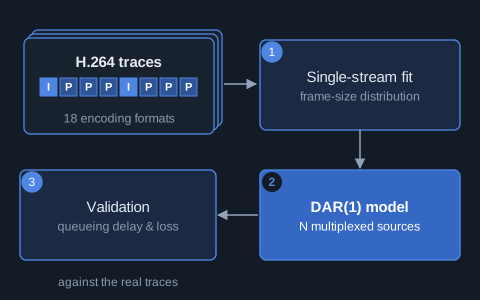
    One of the first traffic models for H.264 videoconferencing: a DAR(1) model that captures many multiplexed H.264 streams from simple statistics.

    • Fits single H.264 streams in 18 encoding formats to standard distributions.
    • Builds and validates a DAR(1) model for multiplexed sources.
  10. 2008IWCMC
    Integrating Multimedia Traffic with Strict QoS in Wireless Cellular Networks

    P. Koutsakis and A. Lazaris

    In Proc. of the IEEE International Wireless Communications and Mobile Computing Conference (IWCMC) (invited paper), Limin Hersonissou, Crete, Greece, August 2008

    Evaluates MI-MAC, a reservation access protocol, when H.264 video shares a noisy cellular channel with voice and web traffic under heavy handoff load.

    • One of the first studies to integrate H.264 streams with other multimedia traffic over wireless.
    • Channel throughput above 60% (up to 71%) while meeting each traffic type's QoS.
    • About 25% more voice capacity on average than a well-known competing protocol.
  11. 2008MoViD
    Revenue-Based Call Admission Control for MPEG-4 Wireless Videoconference Traffic

    A. Lazaris and P. Koutsakis

    in Proc. of the 1st IEEE Workshop on Mobile Video Delivery (MoViD, in conjunction with IEEE WoWMoM), Newport Beach, CA, USA, June 2008

    Admission control for wireless videoconferencing that weighs predicted capacity against the revenue gained by degrading some users to admit others.

    • Traffic model for medium-quality MPEG-4 videoconference.
    • Revenue-aware admission decisions, reaching up to 77% system throughput with good QoS.
  12. 2007MobiWAC
    Scheduling for H.264 Video Traffic over GEO Satellite Networks

    P. Koutsakis, M. Giannotta, A. Ianos and A. Lazaris

    In Proc. of the 5th ACM International Workshop on Mobility Management and Wireless Access (MobiWAC), Chania, Greece, October 2007

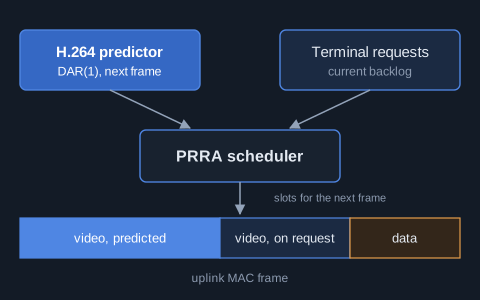
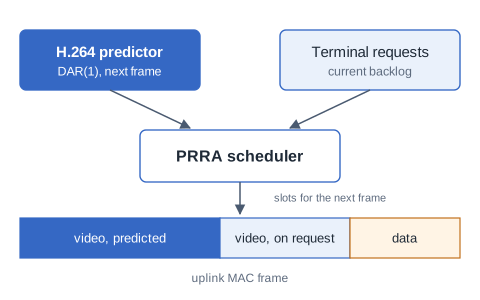
    PRRA: dynamic bandwidth allocation for satellite uplinks that reserves capacity using accurate H.264 traffic prediction.

    • DAR(1) model of single and multiplexed H.264 streams used for proactive scheduling.
    • Handles 63% system load under a strict 0.1% packet-drop target, close to an ideal scheduler (72%).
  13. 2006NEW2AN
    A New MAC Protocol Based on Multimedia Traffic Prediction in Satellite Systems

    P. Koutsakis and A. Lazaris

    in Proc. the 6th International Conference on Next Generation Teletraffic and Wired/Wireless Advanced Networking (NEW2AN), St. Petersburg, Russia, May 2006

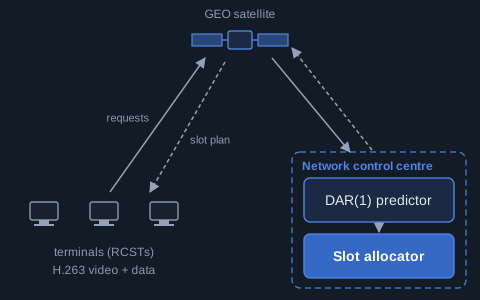
    A satellite access control protocol for the DVB-RCS return channel that uses videoconference traffic prediction to allocate bandwidth ahead of demand.

    • DAR(1) model of multiplexed H.263 videoconference used for prediction.
    • Reaches 76% to 83% throughput, close to an ideal allocator and over twice peak-rate allocation.
  14. 2006NEW2AN
    On Modeling Video Traffic from Multiplexed MPEG-4 Videoconference Streams

    A. Lazaris, P. Koutsakis and M. Paterakis

    In Proc. of the 6th International Conference on Next Generation Teletraffic and Wired/Wireless Advanced Networking (NEW2AN), St. Petersburg, Russia, May 2006

    Early work on modeling multiplexed MPEG-4 videoconference traffic with a Discrete Autoregressive model.

    • Distribution fitting on four long MPEG-4 videoconference traces.
    • DAR(1) model that tracks real multiplexed traffic closely for P and B frames.

Professional service

Academic community

Technical Program Committee

  • IEEE ICC (CRN) 2012-2015
  • IEEE ICCCT 2011-2013
  • IEEE ICCVE 2012-2014
  • IEEE ISWTA 2012-2013
  • IEEE ICPCA 2009-2011
  • IEEE ISCI 2013
  • IEEE PECON 2012
  • IEEE ISIEA 2012

Organizing Committees

  • Publication Co-Chair, IEEE WoWMoM 2013, Madrid, Spain
  • Publicity Co-Chair, IEEE Workshop on Video Everywhere (ViDEv), with IEEE WoWMoM 2012, 2014, 2015

Journal Reviewer

  • IEEE Transactions on Network and Service Management
  • IEEE Journal on Selected Areas in Communications
  • Computer Communications (Elsevier)
  • Knowledge-Based Systems (Elsevier)
  • Pervasive and Mobile Computing (Elsevier)
  • Simulation Modelling Practice and Theory (Elsevier)
  • Journal of Systems and Software (Elsevier)

Conference Reviewer

  • IEEE ASAP 2020
  • IEEE/ACM CCGrid 2020
  • ACM SIGCOMM HotSDN 2014
  • IEEE INFOCOM 2012
  • IEEE INFOCOM MoViD Workshop 2009
  • IEEE MILCOM 2010
  • IEEE PerCom 2009-2010
  • IEEE ICC 2008-2010
  • IEEE GLOBECOM 2007-2010
  • IEEE ICCCN 2009
  • IEEE WMCNT 2009
  • IEEE LCN 2008-2009
  • IEEE MMSP 2007

Get in touch

The best way to reach me is a message on LinkedIn.
Message me on LinkedIn