Tango: Simplifying SDN Programming with Automatic Switch Behavior Inference, Abstraction, and Optimization
In Proc. of the 10th ACM International Conference on emerging Networking Experiments and Technologies (CoNEXT), Sydney, Australia, December 2014
Overview
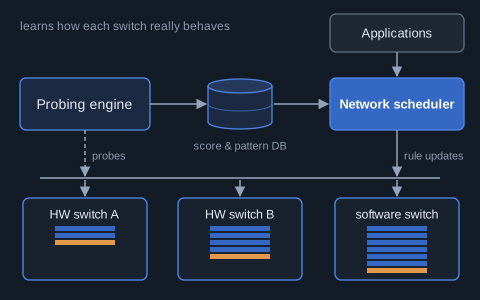
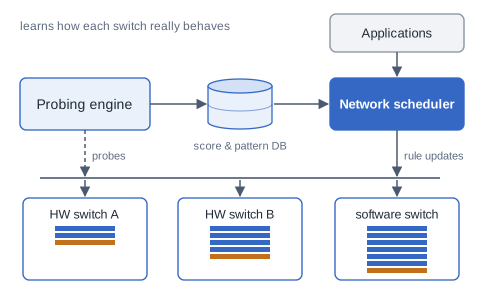
Tango lets SDN controllers handle the hidden diversity of real OpenFlow switches: it probes each switch to learn how it really behaves, then optimizes how rules are installed.
Key contributions
- Probing engine that infers switch properties, such as flow-table size, within 5% of the true value.
- Simple API for applications to state requirements, with automatic rewriting into the fastest equivalent switch operations.
- Up to 70% faster rule installation on hardware switches.
Abstract
A major benefit of software-defined networking (SDN) over traditional networking is simpler and easier control of network devices. The diversity of SDN switch implementation properties, which include both diverse switch hardware capabilities and diverse controlplane software behaviors, however, can make it difficult to understand and/or to control the switches in an SDN network. In this paper, we present Tango, a novel framework to explore the issues of understanding and optimization of SDN control, in the presence of switch diversity. The basic idea of Tango is novel, simple, and yet quite powerful. In particular, different from all previous SDN control systems, which either ignore switch diversity or depend on that switches can and will report diverse switch implementation properties, Tango introduces a novel, proactive probing engine that infers key switch capabilities and behaviors, according to a well-structured set of Tango patterns, where a Tango pattern consists of a sequence of standard OpenFlow commands and a corresponding data traffic pattern. Utilizing the inference results from Tango patterns and additional application API hints, Tango conducts automatic switch control optimization, despite diverse switch capabilities and behaviors.
Cite this paper
@inproceedings{DBLP:conf/conext/LazarisTHLVYY14,
  author    = {Aggelos Lazaris and
               Daniel Tahara and
               Xin Huang and
               Erran L. Li and
               Andreas Voellmy and
               Yang Richard Yang and
               Minlan Yu},
  title     = {Tango: Simplifying {SDN} Control with Automatic Switch Property Inference,
               Abstraction, and Optimization},
  booktitle = {Proceedings of the 10th {ACM} International on Conference on emerging
               Networking Experiments and Technologies, CoNEXT 2014, Sydney, Australia,
               December 2-5, 2014},
  pages     = {199--212},
  year      = {2014},
  crossref  = {DBLP:conf/conext/2014},
  url       = {https://doi.org/10.1145/2674005.2675011},
  doi       = {10.1145/2674005.2675011},
  timestamp = {Tue, 06 Nov 2018 00:00:00 +0100},
  biburl    = {https://dblp.org/rec/bib/conf/conext/LazarisTHLVYY14},
  bibsource = {dblp computer science bibliography, https://dblp.org}
}