User Satisfaction-Based Resource Allocation for GEO Satellites
In Proc. of the IEEE WoWMoM, San Francisco, CA, USA, June 2012
Overview
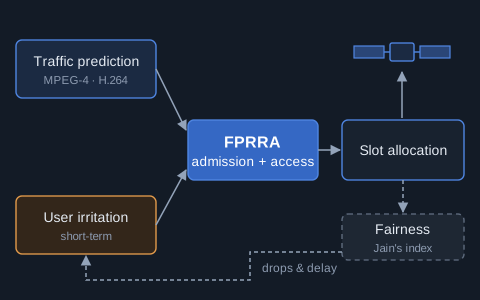
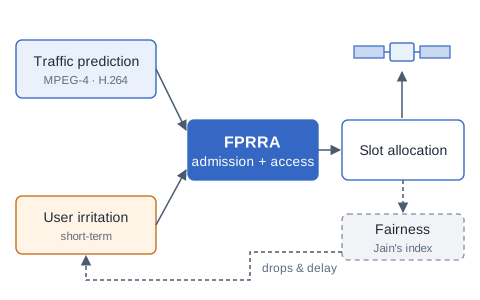
Extends FPRRA, a joint admission and access control framework for satellite links, so it accounts for user satisfaction and still performs well when video traffic is hard to model.
Key contributions
- Two definitions of short-term user irritation built into the scheduler.
- Evaluation on highly bursty MPEG-4 and H.264 traces where prediction is less accurate.
- Fairness analysis with Jain's index.
Abstract
In recent work we have introduced and evaluated a fair and dynamic joint Call Admission Control (CAC) and Multiple Access Control (MAC) framework, for Geostationary Orbit (GEO) Satellite Systems, named Fair Predictive Resource Reservation Access (FPRRA). The framework was based on accurate videoconference and data traffic prediction, made decisions after taking into account the provider’s revenue, and was shown to be highly efficient. In this paper we enhance FPRRA by talking into account the users’ satisfaction for making scheduling decisions and we focus on its evaluation in the absence of accurate MPEG-4 and H.264 video traffic modeling. In addition, we discuss the efficiency of our proposed scheme in comparison to other efficient schemes from the literature.
Cite this paper
@inproceedings{DBLP:conf/wowmom/StamosVKSVLK12,
  author    = {Charalabos Stamos and
               Dimitra Vasileiadou and
               Georgia Koutsandria and
               Irene Spanou and
               Aikaterini Vlachaki and
               Aggelos Lazaris and
               Polychronis Koutsakis},
  title     = {User satisfaction-based resource allocation for {GEO} satellites},
  booktitle = {2012 {IEEE} International Symposium on a World of Wireless, Mobile
               and Multimedia Networks, WoWMoM 2012, San Francisco, CA, USA, June
               25-28, 2012},
  pages     = {1--3},
  year      = {2012},
  crossref  = {DBLP:conf/wowmom/2012},
  url       = {https://doi.org/10.1109/WoWMoM.2012.6263727},
  doi       = {10.1109/WoWMoM.2012.6263727},
  timestamp = {Fri, 27 Dec 2019 00:00:00 +0100},
  biburl    = {https://dblp.org/rec/bib/conf/wowmom/StamosVKSVLK12},
  bibsource = {dblp computer science bibliography, https://dblp.org}
}