A New Bandwidth Allocation Mechanism for Next Generation Wireless Cellular Networks
ACM Wireless Networks Journal, Vol. 16, No. 2, 2010, pp. 331-353
Overview
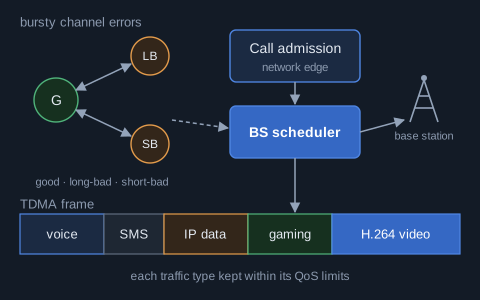
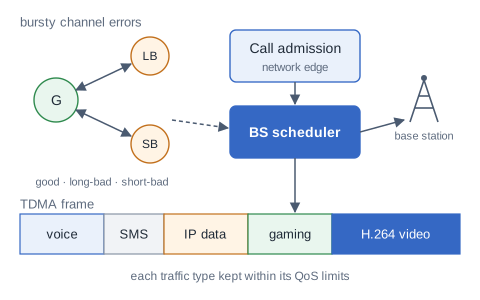
Designs a medium access control protocol that lets voice, messaging, IP data, online gaming and H.264 video share a high-speed cellular TDMA channel with errors, while keeping each traffic type within its QoS limits.
Key contributions
- One of the first studies to integrate real H.264 video traces and gaming traffic with other traffic over wireless.
- Base-station scheduling combined with call admission control at the network edge.
- About 7% to 10% higher throughput than competing protocols and 16% to 28% more voice capacity on average.
Abstract
In this paper we design and study the performance of a Medium Access Control (MAC) scheme for the multiplexing and the integrated delivery of voice, mobile messaging, IP, gaming and H.264 videoconference traffic over a high-speed cellular TDMA channel with errors and capture. To the best of our knowledge, this is one of the first papers in the literature investigating the integration of actual H.264 video traces and gaming traffic with other types of traffic over wireless networks. Our results show that the proposed scheme achieves high throughput results while preserving the strict Quality of Service (QoS) requirements of each traffic type, and outperforms two efficient schemes previously proposed in the literature.
Cite this paper
@article{DBLP:journals/winet/KoutsakisVL10,
	author    = {Polychronis Koutsakis and
	Moisis Vafiadis and
	Aggelos Lazaris},
	title     = {A new bandwidth allocation mechanism for next generation wireless
	cellular networks},
	journal   = {Wireless Networks},
	volume    = {16},
	number    = {2},
	pages     = {331--353},
	year      = {2010},
	url       = {https://doi.org/10.1007/s11276-008-0132-3},
	doi       = {10.1007/s11276-008-0132-3},
	timestamp = {Fri, 27 Dec 2019 00:00:00 +0100},
	biburl    = {https://dblp.org/rec/bib/journals/winet/KoutsakisVL10},
	bibsource = {dblp computer science bibliography, https://dblp.org}
}