Video Scene Identification And Classification For User-tailored QoE in GEO Satellites
Human-centric Computing and Information Sciences, 7, 1, Article 96 (December 2017), 18 pages, 2017
Overview
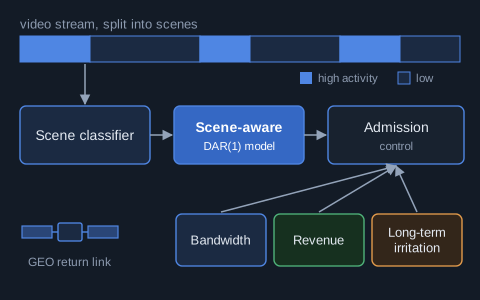
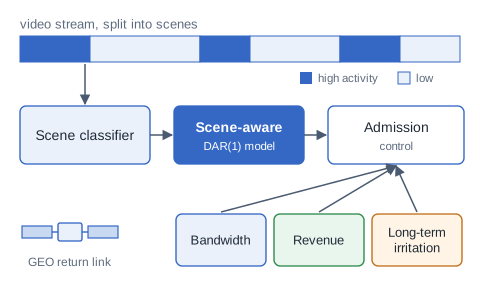
Brings video scene identification and classification into satellite resource allocation, so admission and scheduling decisions track each user's long-term Quality of Experience, not just average QoS.
Key contributions
- Scene-level traffic model that separates high- and low-activity scenes in bursty video.
- Introduces long-term user satisfaction (“irritation”) into call admission control, alongside bandwidth and provider revenue.
- Handles up to 59% system load under a 0.1% packet-drop target, beating published schemes (32% to 52%), and cuts long-term user irritation by 27%.
Abstract
Satellite networks offer an efficient alternative where no terrestrial networks are available, and can offer a cost effective means of transferring data. Numerous proposals have addressed the problem of resource allocation in geostationary (GEO) satellites, and have been evaluated via various performance metrics related to user Quality of Service (QoS). However, ensuring that on average the users’ QoS requirements are satisfied does not guarantee the satisfaction of their individual Quality of Experience (QoE) requirements, especially in the case of bursty video users. This paper proposes the use of video scene identification and classification for traffic modeling at the scene level in order to improve resource allocation and user QoE in GEO satellite networks. The proposed call admission control and medium access control framework makes decisions based on available bandwidth, long-term and short-term user satisfaction and the revenue that the provider may gain.
Cite this paper
@article{DBLP:journals/hcis/KoutsakisSL17,
  author    = {Polychronis Koutsakis and
               Irene Spanou and
               Aggelos Lazaris},
  title     = {Video scene identification and classification for user-tailored QoE
               in {GEO} satellites},
  journal   = {{HCIS}},
  volume    = {7},
  pages     = {15},
  year      = {2017},
  url       = {https://doi.org/10.1186/s13673-017-0096-3},
  doi       = {10.1186/s13673-017-0096-3},
  timestamp = {Fri, 27 Dec 2019 00:00:00 +0100},
  biburl    = {https://dblp.org/rec/bib/journals/hcis/KoutsakisSL17},
  bibsource = {dblp computer science bibliography, https://dblp.org}
}