Modeling Video Traffic from Multiplexed H.264 Videoconference Streams
In Proc. of the IEEE GLOBECOM, New Orleans, USA, December 2008
Overview
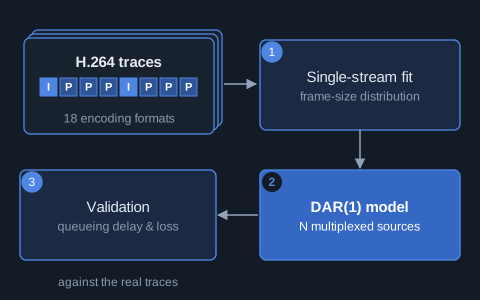
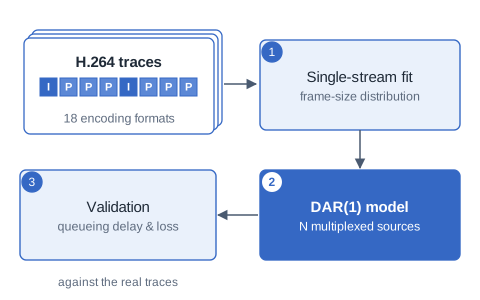
One of the first traffic models for H.264 videoconferencing: a DAR(1) model that captures many multiplexed H.264 streams from simple statistics.
Key contributions
- Fits single H.264 streams in 18 encoding formats to standard distributions.
- Builds and validates a DAR(1) model for multiplexed sources.
Abstract
Due to the burstiness of video traffic, video modeling is very important in order to evaluate the performance of future wired and wireless networks. In this paper, we investigate the possibility of modeling H.264 videoconference traffic with well-known distributions. Our results regarding the behavior of single videoconference traces provide significant insight and help to build a Discrete Autoregressive (DAR(1)) model to capture the behavior of multiplexed H.264 videoconference movies from VBR coders.
Cite this paper
@inproceedings{DBLP:conf/globecom/LazarisK08,
  author    = {Aggelos Lazaris and
               Polychronis Koutsakis},
  title     = {Modeling Video Traffic from Multiplexed {H.264} Videoconference Streams},
  booktitle = {Proceedings of the Global Communications Conference, 2008. {GLOBECOM}
               2008, New Orleans, LA, USA, 30 November - 4 December 2008},
  pages     = {1479--1484},
  year      = {2008},
  crossref  = {DBLP:conf/globecom/2008},
  url       = {https://doi.org/10.1109/GLOCOM.2008.ECP.289},
  doi       = {10.1109/GLOCOM.2008.ECP.289},
  timestamp = {Fri, 27 Dec 2019 00:00:00 +0100},
  biburl    = {https://dblp.org/rec/bib/conf/globecom/LazarisK08},
  bibsource = {dblp computer science bibliography, https://dblp.org}
}