Modeling Multiplexed Traffic from H.264/AVC Videoconference Streams
Computer Communications Journal, Elsevier Publ, Vol. 33, No. 10, 2010, pp. 1235-1242
Overview
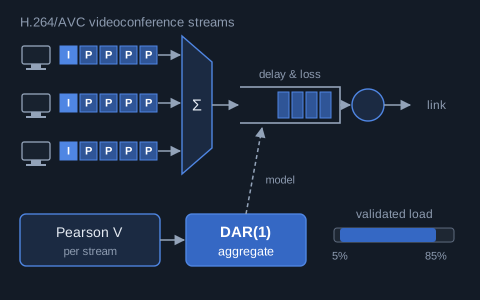
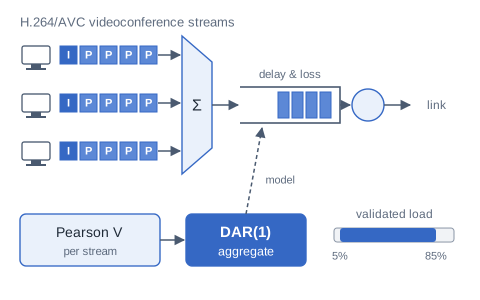
Shows how to model the aggregate traffic of many multiplexed H.264/AVC videoconference streams with a simple Discrete Autoregressive model built from per-stream statistics.
Key contributions
- Fits single H.264 streams against common distributions and identifies Pearson type V as the best fit.
- Builds a DAR(1) model that accurately reproduces queueing delay and packet loss of multiplexed sources at loads from 5% to 85%.
Abstract
In this correspondence, we initially investigate the statistical behavior of bursty video traffic originating from single H.264/AVC streams, by modeling it with well-known distributions. Our results help to build a Discrete Autoregressive model which captures well the behavior of multiplexed H.264/AVC videoconference sources.
Cite this paper
@article{DBLP:journals/comcom/LazarisK10,
  author    = {Aggelos Lazaris and
               Polychronis Koutsakis},
  title     = {Modeling multiplexed traffic from {H.264/AVC} videoconference streams},
  journal   = {Computer Communications},
  volume    = {33},
  number    = {10},
  pages     = {1235--1242},
  year      = {2010},
  url       = {https://doi.org/10.1016/j.comcom.2010.03.014},
  doi       = {10.1016/j.comcom.2010.03.014},
  timestamp = {Fri, 27 Dec 2019 00:00:00 +0100},
  biburl    = {https://dblp.org/rec/bib/journals/comcom/LazarisK10},
  bibsource = {dblp computer science bibliography, https://dblp.org}
}